Why your ITSM was built for a world that no longer exists

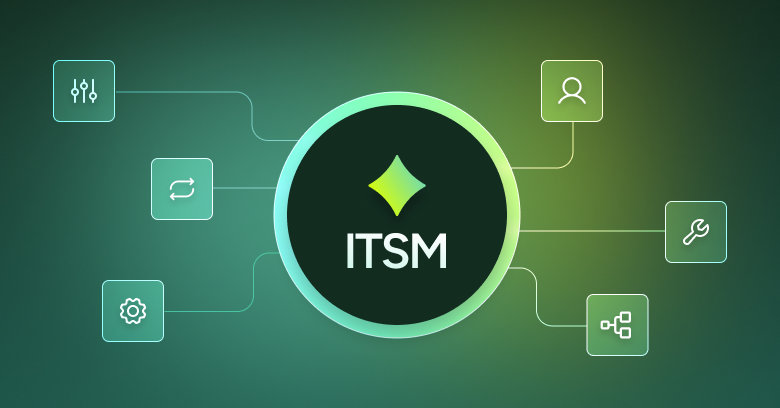
The ITSM (IT Service Management) market is booming. Valued at almost $15 billion in 2026 and projected to reach close to 48 billion by 2033, investment in IT service management has never been higher. And yet, many IT leaders find themselves in a paradox: they’re spending more on ITSM, while feeling less in control than ever before.
The reason isn’t a lack of budget or the wrong tool. It’s that the environment ITSM was originally designed to manage no longer exists, and the gap between the world ITSM frameworks were built for and the one IT leaders actually operate in is growing wider every year.
Once upon a time, IT controlled everything.
Cast your mind back to when the foundational principles of modern ITSM were being written. IT sat at the center of a clearly defined, controllable universe. The infrastructure was on-premise. The tools were chosen, procured, and deployed by IT. The perimeter was physical. Change happened in predictable cycles, governed by committees and approved in advance.
Frameworks like ITIL (Information Technology Infrastructure Library) thrived in that environment. Centralized control and rigid change cycles weren’t just rules; they were practical responses to a predictable world. IT held the keys, and ITSM was the gate. But the cloud did more than just move servers; it dismantled the very perimeters that governance relied on. Suddenly, managing IT meant dealing with a landscape far more fluid and complex than any manual could anticipate.
Before there was shadow IT, there was trust.
For a long time, employees trusted IT to provide the tools they needed to do their jobs. And for the most part, IT delivered. But in the world of immediate gratification and accelerated business, people don’t want to wait for a new software solution. They want it now. So, rather than waiting for IT to deliver, they started finding their own solutions.
Shadow IT is no longer an exception in enterprise environments; it’s become a structural feature. Nearly half of all SaaS applications in the average enterprise sit outside formal IT governance, and the problem is accelerating. According to a Productiv analysis, when ChatGPT launched in late 2022, it didn’t even appear on the list of top unauthorized enterprise applications. By 2023, it had taken the number one slot.
The instinct in traditional ITSM is to treat this as a compliance problem: block, restrict, report, remediate. But that response misdiagnoses what shadow IT actually is: a signal. When employees consistently bypass ITSM processes to get work done, they’re not being reckless. They’re telling you the service model isn’t keeping pace with the business’s needs.
The organizations that handle shadow IT most effectively don’t try to eliminate it through enforcement. They compete with it by making sanctioned ITSM processes faster, simpler, and more useful than the workaround.
Then along came AI, and everything changed.
Just as organizations were beginning to adapt their ITSM strategies to a cloud-first, SaaS-heavy world, artificial intelligence arrived, introducing a new category of disruption that traditional ITSM frameworks weren’t designed to handle.
AI adoption within the enterprise is accelerating faster than governance can keep up with. According to Gartner, 40% of enterprise applications will be integrated with task-specific AI agents by the end of 2026, up from less than 5% in 2025, a pace that most ITSM frameworks simply weren’t designed to manage. And unlike previous technology shifts, AI doesn’t just introduce new tools into the environment. It introduces tools that learn, adapt, and affect outputs in ways that don’t follow predictable patterns.
The upside is real, too. AI is already handling a significant share of Tier 1 (high-volume, low-complexity) tickets autonomously, freeing IT teams from the repetitive, low-value requests that have historically consumed a disproportionate amount of their time. For IT leaders, that’s not just an efficiency gain—it’s a chance to redirect capacity toward the strategic work that actually moves the business forward.
But realizing that upside requires an ITSM framework built to work with AI, not one that treats it as just another incident category to manage.
What modern ITSM actually looks like
None of this means ITSM is obsolete. It means the underlying assumptions need updating. The IT leaders navigating this environment most effectively have made three important shifts in how they think about ITSM.
- From gatekeeping to enabling. The goal of ITSM is no longer about controlling which technologies enter the organization. The goal is to make governed, supported ITSM processes so good that they become the obvious choice. When the service desk is faster than the workaround, shadow IT loses its appeal.
- From reactive governance to continuous visibility. In an on-premise world, IT could audit what was happening periodically. In a cloud and AI-native environment, visibility needs to be real-time. Modern ITSM strategies prioritize knowing what’s happening across the environment at all times, not as a control mechanism, but as a precondition for managing it effectively.
- From process-first to outcome-first. Traditional ITSM measures itself by process compliance: were the right steps followed, were SLAs met, were tickets closed?
Modern ITSM measures itself by outcomes: did employees get what they needed, did the business stay productive, did IT reduce risk? The metrics look different, and so do the decisions they drive.
The future of ITSM is already here
The organizations that built their ITSM strategies for an on-premise, IT-controlled, predictably paced world aren’t failing because they made bad decisions. They made good decisions for the environment that existed at the time.
But that environment is gone. The IT leaders who recognize this and are willing to rethink their ITSM approach in light of the realities of cloud, shadow IT, and AI are the ones who will turn ITSM from a cost of operations into a driver of business performance.
The question isn’t whether your ITSM needs to evolve. It’s whether you’ll lead that evolution, or find yourself managing the consequences of not doing so.
Ready to see what modern ITSM looks like in practice? Sign up for a SysAid free trial.
Did you find this interesting?Share it with others:
Did you find this interesting? Share it with others:
Freshservice vs SysAid: everything you need to know

Only 1 in 10 IT teams has full software visibility. Here’s what it’s costing them.
Incident management for manufacturing: the cost every minute the line is down
AI agents in ITSM: Why are only 13% of IT leaders using them?

Why manufacturing floor issues never become IT tickets

Confront shadow IT with the SysAid Browser Extension