

The Future of BI with AI

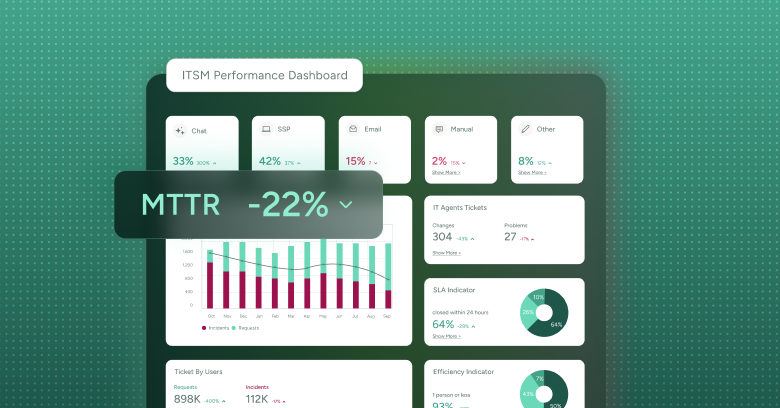
Business intelligence (BI) is not a new capability within IT service management (ITSM). However, the use of generative artificial intelligence (GenAI) capabilities within ITSM tools or platforms now significantly alters the position of BI within ITSM. After 30 years of industry conversations about the wealth of data and information that can be “trapped” within ITSM tools, GenAI allows your organization and its employees to better access this without needing specialized skills or knowledge.
However, these access limitations are not the only BI issue that GenAI can help with. There’s a great Gartner Research quote – from the “Is Your Business Intelligence Enabling Intelligent Business?” (ID: G00769305) research paper by Julian Sun, published 9 March 2023 – that should be an eye-opener for ITSM professionals: “Business Intelligence (BI) and analytics have traditionally been used for generating reports and dashboards, but their true potential in driving business outcomes often remains untapped.” Your IT organization might need better access to ITSM data and insight, but it must also align its better BI capabilities with business value.
With this in mind, this blog explains the future of BI in ITSM, thanks to the power of GenAI.
Why BI is so important to ITSM
ITSM practices have always involved data and decision-making. However, the ability of ITSM professionals to make data-informed decisions has often been stifled by their inability to access, interpret, and leverage the data in their ITSM tools.
BI capabilities have helped – offering the ability to transform the vast amount of data (in ITSM tools) into actionable insights related to:
- Optimizing operations – for example, improving resource allocation, incident prioritization, and change management
- Improving service delivery and end-user experiences
- Enhancing decision-making related to strategic direction and improvement.
However, this has traditionally been a centralized or specialist capability.
Better BI capabilities are a great opportunity for ITSM. However, until now, various factors have conspired to slow BI’s mainstream ITSM adoption.
The barriers to greater BI use
You might think that budget and technology availability are the primary barriers to greater BI use in ITSM. They often are, along with data silos caused by disparate systems and tools that lead to fragmented data. Plus, non-technical users might struggle to derive value from BI insights.
Gartner Research – in its research paper “How to Manage Stakeholder Expectations for Your Analytics Initiatives” (ID: G00811908) by Jamie O’Brien and Anirudh Ganeshan, published 24 September 2024 – stated that “Heads of Analytics & BI struggle with stakeholder management, impacting delivery of analytics initiatives.” The paper offers guidance on the need for better understanding communities, maximizing the value that these communities bring, and mitigating community behaviors that hinder delivery and value creation.
It also offers three strategic insights to Chief Data & Analytics Officers (CDAOs) in support of this:
- “By 2026, 75% of CDAOs who don’t prioritize influence will be assimilated into tech functions.
- By 2027, more than half of CDAOs will secure funding for data & AI literacy programs to meet GenAI demands.
- By 2025, 90% of analytics content consumers will become creators enabled by AI.”
The latter two insights recognize the importance of AI in democratizing BI use throughout your organization, including in the IT organization and ITSM capabilities.
However, organizations are still left with the need to ensure BI use cases and success factors are focused on business value and not just the processes and dashboards involved! The democratization of BI in ITSM will help with this.
How GenAI is driving the future of BI in ITSM
While many people might initially view the GenAI capabilities in ITSM tools as routes to better IT efficiency, there are also many BI-related opportunities. As already mentioned, GenAI democratizes BI capabilities, with IT staff of all levels able to access data and insights to help inform their decision-making without needing data specialists.
The future of BI in ITSM thus involves both a “pull” and “push” approach to data and insight access. CDAOs and their teams might provide your IT organization with centralized capabilities (the “push”). However, GenAI capabilities offer your people self-service or “pull” BI capabilities that require minimal BI knowledge or experience.
For example, these GenAI capabilities allow your service desk leaders and agents to access performance data and create custom reports and visualizations tailored to their needs (it’s self-service BI invoked using conversational queries rather than complicated commands). These can be historical and trend-based, or your IT team can act on live data to improve responsiveness. GenAI capabilities can also offer predictive analytics, which analyzes historical data to predict future issues, demand, or required changes.
Example use cases for GenAI-powered BI in ITSM
There are various opportunities for GenAI-powered BI to improve your IT organization’s ITSM operations and outcomes. These include:
- Predictive incident management – integrating GenAI-powered predictive analytics into ITSM workflows helps ensure proactive issue resolution. For example, monitoring dashboards can alert IT support staff about server performance issues before they impact end-users. Alternatively, the GenAI capabilities can invoke the required automation to resolve the issue without human involvement.
- Proactive problem management – GenAI-powered incident data pattern analysis helps your IT teams identify recurring issues (problems). It can also undertake root-cause analysis to identify and address the root cause or causes. This proactive problem management reduces repeat issues and long-term incident volumes.
- SLA compliance and optimization – GenAI-powered dashboards can track service level agreement (SLA) metrics and key performance indicators (KPIs) in real time, alerting your teams to potential SLA breaches before they happen. GenAI-based historical data analysis can also guide SLA renegotiations to reflect more realistic goals.
- Cost optimization – GenAI-powered BI capabilities can analyze ITSM resource usage to help your teams identify improvement opportunities and inefficiencies. This could apply to people assignment, service level agreement parameters, process-based waste, or unnecessary expenditure. For example, identifying underutilized software licenses will save procurement costs.
Examples of GenAI-powered BI in action
SysAid is already leveraging Gen-AI-powered BI capabilities to help customers. GenAI can quickly access performance details using natural language queries. For example, the SysAid Copilot for Agents will provide the team’s MTTR for last week on request. You can also ask it to break it down by incident priority or compare it to last week’s performance.
GenAI can also “push” key data and insights to ITSM staff. For example, SysAid’s AI Insight Report provides your staff with up-to-date performance information, highlighting their average (personal) MTTR, their “incidents closed within 24 hours” percentage, and the average user satisfaction score received. It also offers predictions for the week ahead.
Just think about how this data and insight will improve team and personal performance and its positive impact on your IT service delivery and support operations and outcomes. To help, SysAid offers you powerful tools like real-time dashboards, BI Analytics, AI Insights, and AI agents that help you with analytics and analyze activity and what’s happening in your queue.
To learn more about how GenAI and SysAid Copilot for Agents will accelerate the future of BI in your ITSM capabilities, take a look here.
Did you find this interesting?Share it with others:
Did you find this interesting? Share it with others:
Why your ITSM was built for a world that no longer exists
SysAid’s AI Agent Center: Command and control for your AI Agents
Take control of software license compliance with SysAid License Manager

Why IT teams are afraid to innovate, and what it’s costing them

The hidden cost of institutional knowledge in IT
Elevating Customer Support: How Help Desk Software Enhances User Experience