

Stop making employees wait: The case for an IT self-service portal that actually works

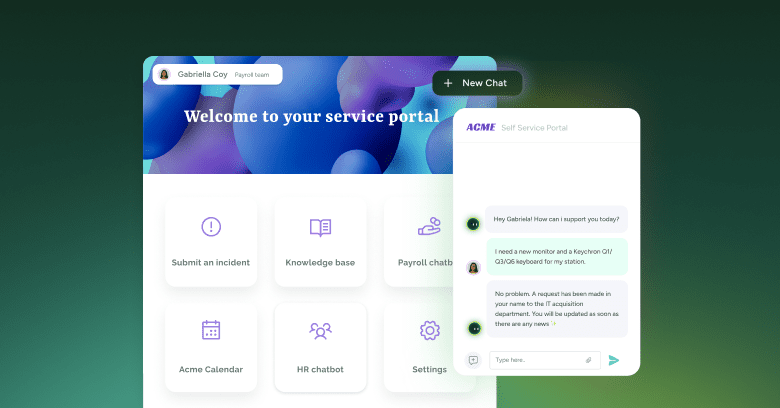
Ask most employees about their company’s self-service IT portal, and you’ll hear a familiar complaint: “I tried it once, didn’t get what I needed, and just emailed the IT team instead.”
It’s a telling response.
For context, Gartner estimates that 20-50% of all support tickets are for password resets, meaning skilled IT technicians spend a significant chunk of their day unlocking accounts. And the employees waiting for a resolution aren’t thrilled either. Nobody wants to sit idle for something that should take two minutes.
A well-built IT self-service portal is the answer to both problems. It serves as the foundation for IT service management automation, ensuring that routine fixes don’t require human intervention. Not as a way to dodge user requests or cut headcount, but as a smarter way to get people back to work faster while giving IT teams the breathing room they need to focus on what actually needs them.
Why most self-service portals fall short
The core failure of many first-generation portals was that they were built with the IT team’s taxonomy in mind rather than the user’s mental model. The documentation was written in technical language. Search returned irrelevant results because legacy systems lacked the context provided by generative AI knowledge management. Without it, portals remained static libraries rather than active problem-solvers. Request forms felt more like bureaucratic hurdles than helpful tools. The experience was so friction-heavy that employees concluded it was faster to submit a support request.
But the problem isn’t with the concept. It’s with the execution. A self-service portal shouldn’t just redirect users away from human support. It should speak their language and resolve their issues faster, at any hour.
The real advantages: realizing self-service portal benefits
1. Speed without compromise
The most immediate benefit of a functional self-service portal is the time it saves for everyone involved. When an employee can reset their own password at 7:30 AM before an early morning meeting, they don’t have to wait for the IT department to start their day. When employees can provision software access through an automated approval workflow, a process that used to take days can take minutes.
Resolution time is one of the most telling metrics in IT service management. Each potential ticket resolved through self-service never enters the queue, requires no triage, and doesn’t occupy a technician’s time. The downstream effect compounds: shorter queues mean faster response times for the complex issues that genuinely require human attention.
2. IT teams focused on where it counts
For IT professionals, the promise of self-service isn’t just efficiency. It’s the chance to do more meaningful work.
When a skilled technician spends their day resetting passwords and walking users through the same printer configuration for the fourth time this week, that’s organizational waste. Not because those tasks don’t matter, they do, but because they don’t require the expertise of a highly skilled IT professional.
A strong self-service portal absorbs the predictable, repeatable requests and resolves them through automation or guided knowledge content. The result is an IT function that spends more time on security, infrastructure, strategic initiatives, and the genuinely complex problems that can’t be self-served. That’s better for the team, and ultimately better for the business.
3. 24/7 support without added headcount
Business doesn’t stop outside office hours, especially for distributed or global teams. A self-service portal operates around the clock. An employee in a different time zone who can’t access a critical system at midnight doesn’t have to wait until morning or escalate unnecessarily. This kind of always-on support doesn’t require additional staff. It requires the right infrastructure.
How to make an IT self-service portal that employees actually use
The difference between a self-service portal that gets ignored and self-service IT that becomes the first place employees turn comes down to a few key design principles.
- Relevant, readable content. Ensure that content is written for the person experiencing the problem: clear, step-by-step, and free of unnecessary jargon.
- Simple request forms. If submitting a request feels as complex as filing a tax return, employees will find another path. Forms should ask only what’s necessary and surface smart defaults wherever possible.
- Feedback loops. Users should be able to rate solutions and flag when something didn’t help. This gives IT the data needed to continuously improve the content and close gaps before they become systemic frustrations.
- Seamless escalation. Self-service doesn’t mean abandonment. When a user genuinely needs human help, the path to a technician should be obvious and easy to find, not buried or obstructed. The portal should feel like a resource, not a barrier.
Rethinking self-service as a strategic asset
The organizations getting the most value from IT self-service portals have stopped treating them as deflection tools and have started treating them as strategic assets. They ask not just “how many tickets did this prevent?” but “how much faster are employees getting back to work? How has this changed the experience of being supported by IT?”
When designed with the end user at the center, a self-service portal becomes a genuine extension of the IT team, one that scales infinitely, never gets tired, and delivers consistent quality at any time of day.
Where SysAid comes in
SysAid understands that great IT service management starts with the employee experience. Our platform meets users where they are, with intelligent search, an AI-powered service desk, and intuitive workflows that make resolving common issues fast and frictionless.
For IT teams, SysAid’s Agentic AI acts as a force multiplier. It automatically handles routine and repetitive tasks—such as tickets and requests—often achieving a ticket deflection rate of up to 70%. Therefore, queues stay manageable, and your technicians can focus their expertise on strategic initiatives and complex problems that move the organization forward.
The result is what every IT leader is looking for: faster resolution, happier users, and a team that’s finally able to operate at the level it was built for.
Because the best IT self-service portal isn’t one that replaces your IT team. It’s a self-service portal that makes them, and every employee they support, more effective.
Did you find this interesting?Share it with others:
Did you find this interesting? Share it with others:

Incident management for manufacturing: the cost every minute the line is down
Why manufacturing floor issues never become IT tickets
Confront shadow IT with the SysAid Browser Extension
Your IT team is losing 35% of its capacity to manual work
From firefighting to future-proofing: Using Mean Time to Resolution to build a proactive IT culture

Your IT service desk is drowning. Here’s how to fix it without hiring more people

